


AI for real estate teams: lead qualification and property discovery
NAR found 46% of agents see no impact from AI. Here is where it applies in a real estate team, what it handles, and what has to be ready first.

AI applies to a real estate team in two places where the work repeats and the timing decides the outcome: the first response to an inbound inquiry, and the narrowing of a property set for a buyer. Both run on data the team already holds, which is listing records and CRM history. Neither one replaces the agent's judgment on pricing or negotiation.
Key Takeaways
- The National Association of REALTORS® 2025 Technology Survey found 46% of agents reported no noticeable impact from AI, while 17% reported a significantly positive one.
- Most agent AI use sits in listing copy. The operational work of qualification and follow-up is where the time actually goes.
- One in five buyers now use AI early in the homebuying journey, according to NAR research published in 2026.
- Fair housing obligations, MLS policy, and license law set hard limits on what any qualification logic is allowed to consider.
Where does AI actually apply in a real estate team?
It applies wherever a task repeats on a predictable trigger and runs on structured data the team already owns. The NAR 2025 Technology Survey, published September 18, 2025, found that 20% of agents use AI tools daily, 22% weekly, 27% a few times a month, and 32% had not used them at all. On impact, 17% reported a significantly positive effect, 33% a moderately positive one, and 46% no noticeable effect.
That gap is worth reading carefully. Adoption is broad. Reported effect is narrow. The same survey shows 46% of agents using AI-generated content, mostly for listing descriptions, which is the fastest task to hand over and the smallest one to win back.
Four areas carry more weight than listing copy for a working team. First response to inbound inquiries. Property discovery through conversation. Document and disclosure handling. Follow-up sequencing inside the CRM.
In short: AI in real estate is applied automation running on listing and CRM data. It handles first response, property narrowing, document review, and follow-up scheduling. Judgment on price and negotiation stays with the agent.
What does AI-assisted lead qualification actually do?
It answers the inquiry immediately, gathers the facts the agent needs, and routes the conversation to the right person with a written summary attached. An inquiry arrives on a listing page at 10pm. The assistant answers questions about square footage, taxes, HOA terms, and showing availability, all pulled from the listing record. It asks about timeline, financing status, area preference, and move-in window. The agent opens a summary in the morning instead of a bare email address.
The limits matter as much as the capability. Any qualification logic that touches protected characteristics is off the table. NAR's own guidance is explicit that professionals must comply with license law, fair housing obligations, MLS policy, and data accuracy requirements, with human oversight throughout. Timeline and financing readiness are legitimate qualification inputs. Neighborhood preference inferred as a demographic proxy is not.
In short: AI lead qualification answers property questions from listing data, collects timeline and financing context, and routes the inquiry with a summary. It does not decide which leads deserve attention, and it cannot consider protected characteristics under fair housing rules.
See our AI Business Integration services.
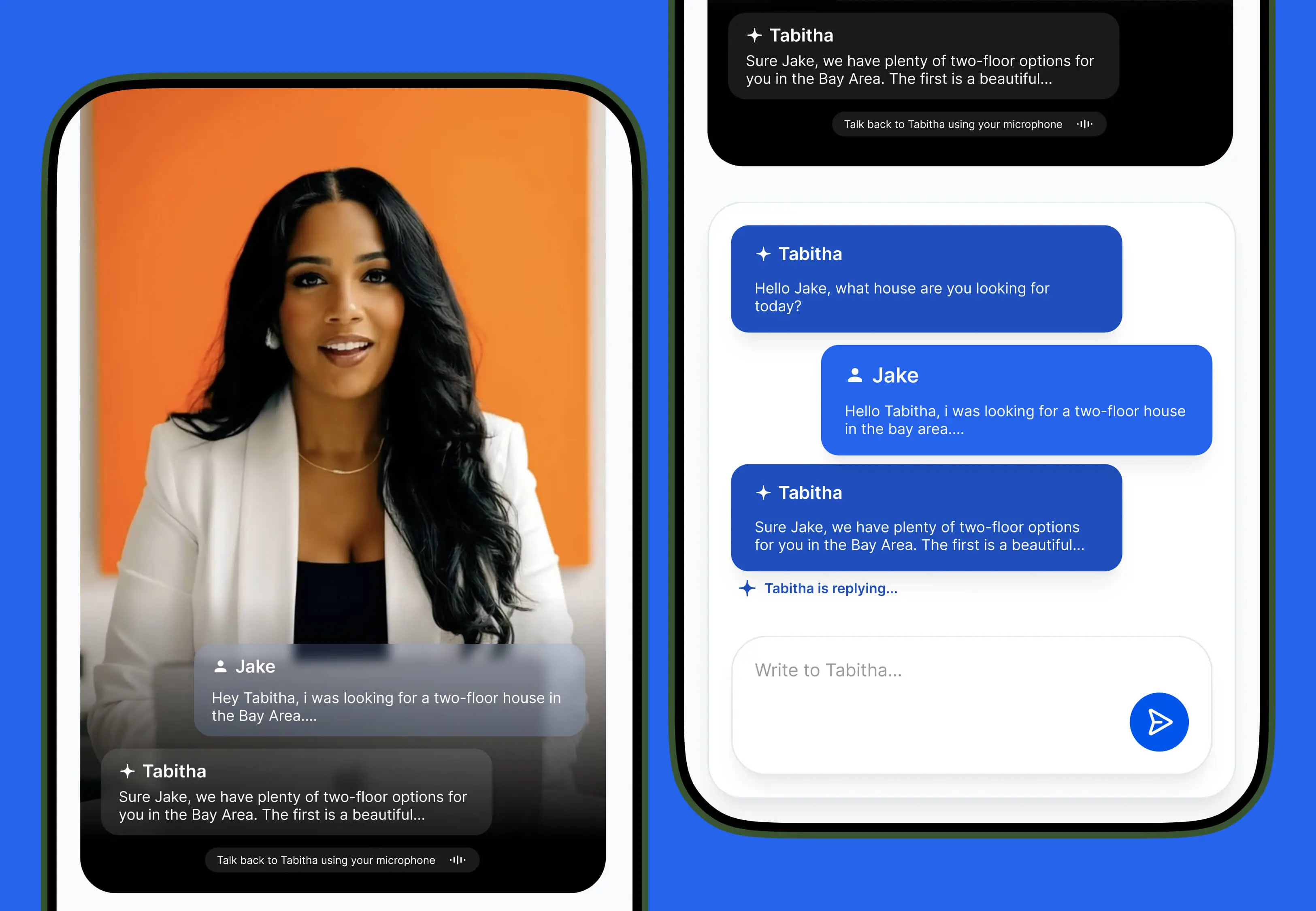
How does conversational property discovery change the search?
It replaces filter boxes with a description, and it starts before the buyer ever contacts an agent. NAR Tech & Innovation reported in August 2026 that one in five buyers already use AI tools early in the homebuying journey, for affordability estimates and neighborhood research among other early tasks. The buyer arrives better briefed and further along.
The search itself is slow. NAR's 2025 Profile of Home Buyers and Sellers put the median search at 10 weeks, with 56% of buyers naming finding the right property as the hardest part of the process. Filters are the reason. A buyer who wants a lake view will never see the listing $15,000 over their slider, even when it is the right house.
A conversational layer works differently. The buyer describes what they want in their own words. The system maps that description against inventory and returns a set with reasoning attached. The agent inherits a preference profile that would otherwise take four showings to assemble. Our own Virtual AI Assistant approaches this as a real-time conversational interaction, where the buyer asks and the assistant answers from verified property data.
See our Virtual AI Assistant for Real Estate.
What has to be in place before any of this works
Structured data, and less of it than teams expect. AI-assisted qualification and discovery both read from records rather than inventing them. When the records are thin, the output is thin. Four things decide whether an integration holds up.
- Listing data with consistent fields. Square footage, HOA terms, tax figures, and showing rules need to live in named fields. Free-text descriptions are not a data source.
- A CRM the team actually updates. Routing rules depend on ownership and status being current. Stale records send inquiries to the wrong agent.
- Written compliance rules. Decide in advance what the assistant may state about a property, what it must defer on, and how disclosures are handled.
- A defined escalation path. Every conversation needs a clear condition for handing off to a person, and a person available to take it.
Where should a team start?
Start with the first response, because it is the highest-frequency task with the clearest measurement. Inquiry volume is known. Response time is measurable before and after. The compliance surface is narrow, since the assistant reads from listing data the team already publishes.
Property discovery comes second. It needs cleaner inventory data and a longer testing period, and its value shows up in showing quality rather than in a single metric. Document handling and follow-up sequencing come after both, once the team trusts the first two.
One caution on the numbers you will read elsewhere. A February 2026 survey by Realtors Property Resource reported that 82% of agents use AI, based on 225 respondents. NAR's survey reached a far larger sample and found 32% had not used AI at all. Read sample size before reading the headline.
Talk to us about an AI opportunity audit.
The Takeaway
Most agents have already tried AI. Under a fifth report a significant effect on the business. That gap comes down to what got handed over, since listing copy is the quickest task to automate and the smallest one to win back.
The return sits in work that repeats on a trigger. An inquiry answered at 10pm from the actual listing record. A buyer preference profile assembled through conversation instead of across four showings. Both read from data the team already keeps, which is why the state of that data decides the outcome before any build begins.
Start with the first response. Inquiry volume is known and response time is measurable, so the result proves itself quickly. Property discovery follows once the listing records hold up. Fair housing obligations set the boundary in either case, and they decide what any qualification logic is allowed to see.
Yes, when the qualification logic is restricted to transaction facts. Timeline, financing readiness, property requirements, and move-in window are permissible inputs. Anything that functions as a proxy for a protected characteristic is not. NAR guidance published in 2026 stresses license law compliance, fair housing obligations, MLS policy, and human oversight for any AI use in practice.
A scripted chatbot matches keywords to canned replies. A conversational discovery layer reads structured listing data and responds to a described need, including context the buyer never entered into a filter. The difference shows in whether the answer references the actual property record.
Cost depends on inquiry volume and how much listing data has to be structured first. The data preparation is usually the larger line item on a first project. A scoped audit of inquiry volume, response times, and current data quality gives a real figure before any build begins.
The transaction data argues against it. NAR's 2025 Profile of Home Buyers and Sellers found that 88% of buyers purchased through an agent or broker, and 91% of sellers used one. Buyers arrive better informed than they did five years ago. They still hire someone to negotiate.








%20(1).svg)