
GEO vs SEO: what's different and why it matters now
SEO earns rankings. GEO earns citations inside AI answers. With organic CTR down 61% on AI Overview queries, here is what changed and what to do.
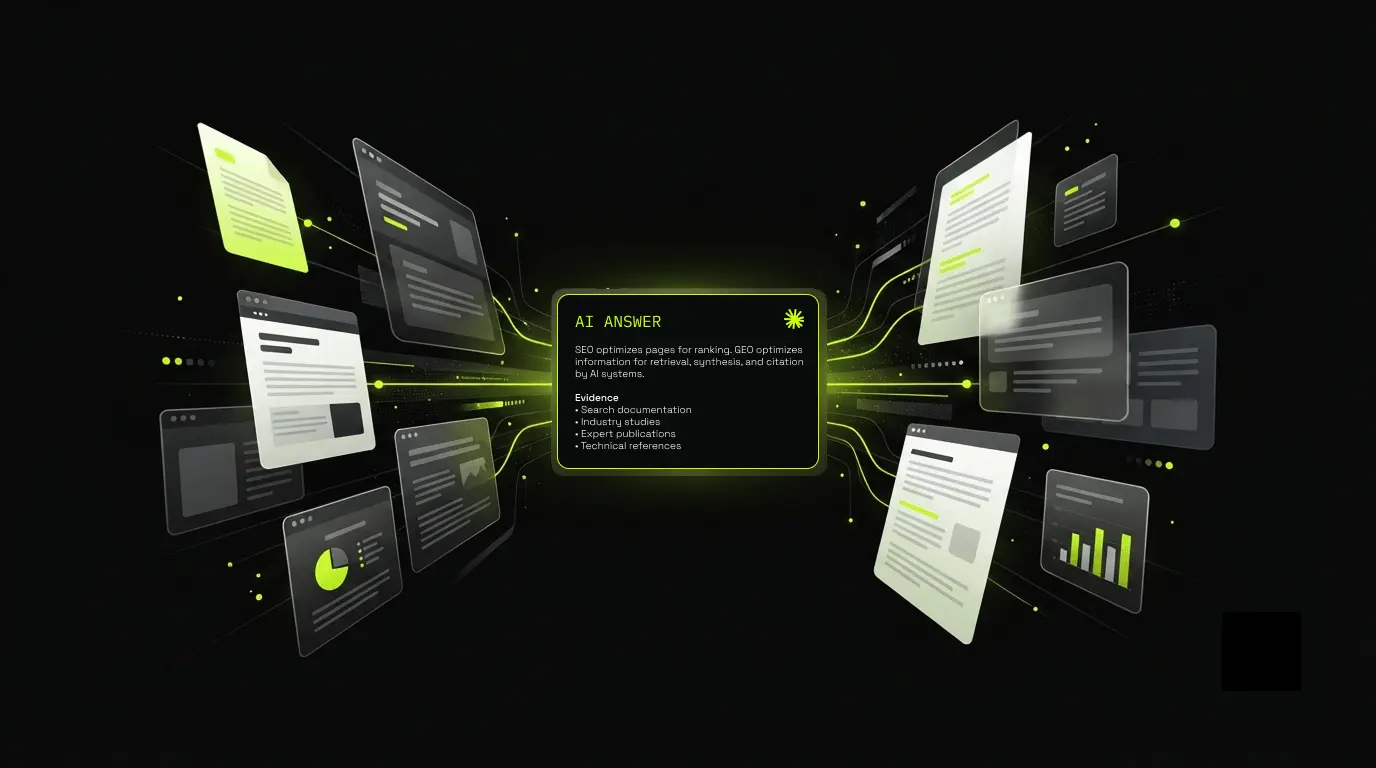
SEO gets your page to rank. GEO gets your brand named inside the answer an AI engine writes. The distinction used to be academic. It stopped being academic the moment people started reading the answer instead of clicking the link.
In 2026, organic click-through rate on queries with a Google AI Overview fell 61% year over year, from 1.76% to 0.61%, based on Seer Interactive's analysis of 3,119 queries across 42 organizations (Seer Interactive, November 2025). The ranking still exists. The click behind it is disappearing. That gap is the whole reason GEO exists as a separate discipline.
Key Takeaways
- SEO optimizes for ranking in a list of links. GEO optimizes for being cited inside an AI-generated answer.
- Organic CTR on AI Overview queries dropped 61% in 2025 (Seer Interactive, 2025), so ranking without citation now leaks traffic.
- GEO does not replace SEO. The technical foundation SEO built is what makes a page citable in the first place.
- AI-referred visitors convert at roughly 4.4x the rate of organic search on average (Semrush, 2025).
What Is SEO and What Is GEO?
SEO is the practice of structuring a site so it ranks in a search engine's list of results. GEO, generative engine optimization, is the practice of structuring content so AI engines quote it inside their generated answers. One competes for a position. The other competes for a mention. As of March 2026, AI Overviews appeared on 48% of Google searches (Conductor via The Stacc, 2026), which means half of all queries now render an answer before the list of links begins.
The mechanics differ because the surface differs. A search engine returns ten blue links and lets the user choose. A generative engine returns one synthesized paragraph and decides, on the user's behalf, which sources deserve a name. SEO answers the question "does Google rank this page." GEO answers a harder question: "when ChatGPT or Perplexity writes about this topic, does it mention us."
The useful way to hold the two ideas together: SEO is about being found, GEO is about being quoted. A page can rank first and never get cited. A page can get cited constantly and never crack the top of the traditional results. The skills overlap. The scoreboards do not.
According to Seer Interactive's 2025 study of 3,119 queries, organic CTR for AI Overview queries fell to 0.61%, a 61% year-over-year decline (Seer Interactive, 2025). The number matters because it separates two things that used to move together. Ranking and traffic have decoupled. GEO is the discipline built for the half of search where that decoupling now lives.
What Actually Changed in Search Behavior?
People stopped clicking. In 2026, roughly 65% of Google searches ended without a click to any website, up from a 58.5% benchmark in 2024 (SparkToro and Datos via EduEarnHub, 2026). When an AI Overview appears, the zero-click rate climbs to about 83%. The answer is the destination now. The link is optional.
Pew Research put a sharp edge on it. Tracking 68,879 real Google searches from 900 US adults in March 2025, Pew found that users clicked a result on just 8% of searches where an AI summary appeared, compared to 15% without one (Pew Research Center, July 2025). Inside the summary itself, only about 1% of users clicked a cited source link. The AI answer satisfies the question. The source rarely earns the visit.
Here is the part that reframes the panic. When AI traffic does click through, it converts. Across studies published in 2025 and 2026, AI-referred visitors converted at roughly 4.4x the rate of standard organic search (Semrush via Run Marshal, 2025). ChatGPT referral traffic converted at 7.1% in one Similarweb clickstream panel, second only to paid search at 7.8% (Similarweb, May 2026). Fewer clicks, higher intent. The visitor arrives already informed, already halfway decided.
The takeaway is not that traffic is dead. Zero-click searches reached roughly 65% of Google in 2026 (SparkToro and Datos, 2026), yet the traffic that survives converts better than what it replaced. The value moved. It did not vanish.

GEO vs SEO: A Side-by-Side
The two disciplines share DNA and diverge on goal. SEO chases position and clicks. GEO chases inclusion and citation. Brands cited in AI Overviews earned 35% more organic clicks than uncited brands appearing in the same overview (DataSlayer, 2026), which is why the mention itself has become the asset.
Goal. SEO ranks a page in the list of results. GEO gets the content cited inside the AI answer.
Unit of success. SEO counts position and click-through. GEO counts mentions, citations, and share of voice in AI answers.
Primary surface. SEO lives on the Google results page and its blue links. GEO lives in AI Overviews, ChatGPT, Perplexity, and Gemini.
What the engine returns. A search engine returns a list of options. A generative engine returns one synthesized answer.
Winning content shape. SEO rewards keyword-relevant, authoritative pages. GEO rewards self-contained, quotable, factually precise passages.
Key signal. SEO leans on backlinks, relevance, and technical health. GEO leans on structure, entity clarity, extractable claims, and freshness.
How you measure it. SEO tracks rankings, organic traffic, and CTR. GEO tracks citation frequency and brand mentions inside AI answers.
Freshness pressure. SEO tolerates older content. GEO does not. Stale passages drop out of answer sets fast.
Read those pairs top to bottom and a pattern surfaces. Everything on the GEO side rewards clarity over cleverness. An AI engine cannot quote a paragraph that hedges, buries its claim, or needs three other paragraphs to make sense. SEO tolerates a certain amount of throat-clearing. GEO punishes it. The content that gets cited is the content that answered the question cleanly enough to lift out whole.
According to Seer Interactive's tracking, about 70% of pages cited in AI Overviews change over a two to three month window, and those changes are not tied to traditional rankings (IDEAVA, 2026). Citation is a live competition, re-run constantly. A page that earns a mention this quarter can lose it next quarter to a fresher, cleaner source. That volatility is the defining texture of GEO work.
Does GEO Replace SEO?
No. GEO sits on top of SEO and depends on it. An AI engine cannot cite a page it cannot crawl, cannot parse, or cannot trust. The technical foundation SEO spent two decades building, clean architecture, crawlability, schema, authority, is the same foundation that makes a page eligible for citation. Kill your SEO and you kill your GEO with it.
The relationship is layered, not competitive. SEO makes a page findable and trustworthy. GEO makes the trustworthy page quotable. In early 2026, organic CTR on AI Overview queries even rebounded from a December 2025 floor of 1.3% to 2.4% by February 2026 (Seer Interactive, May 2026), and the mover was not AI Overview presence. It was whether the brand got cited. Citation, not ranking, decided who kept their clicks.
Our take: The studios treating GEO as a replacement for SEO are misreading the data. The studios treating it as a bolt-on afterthought are missing the shift. GEO is a second scoreboard running on the same infrastructure. You maintain the infrastructure for SEO. You shape the content for GEO. Both, or neither works.
This is why the smart framing is additive. You do not choose GEO instead of SEO any more than you choose the foundation instead of the house. For a deeper breakdown of the discipline itself, see our full explainer on what generative engine optimization is.
How AI Engines Decide What to Cite
AI engines cite content that is structured, self-contained, and specific. A generative model assembling an answer scans for passages it can lift cleanly, attribute confidently, and trust. Vague prose does not survive that filter. As of August 2025, only 2.8% of ChatGPT answers included a citation, up from 0.6% in January 2025 (Similarweb, 2026), so the slots are scarce and the competition for them is real.
Three properties raise a passage's odds of getting quoted.
First, self-contained answers. A paragraph that answers its own question without needing the surrounding context is a paragraph an engine can extract whole. Write the answer to sit alone.
Second, entity clarity. Name the thing. Name the brand, the number, the source. Engines reward content where the who, the what, and the how much are unambiguous and easy to attribute.
Third, freshness. Generative engines penalize dated content, and citation sets churn fast, with roughly 70% of AI Overview citations shifting inside three months (IDEAVA, 2026). A page updated this quarter beats a stronger page left untouched since last year.
None of this is exotic. It is disciplined writing with an engine as the second reader. Answer the question in the first two sentences. State the source. Keep the claim liftable. The same habits that make content clear to a person make it citable to a model.
What GEO Looks Like in Practice
GEO in practice is content engineering, not keyword stuffing. Every page carries a short, quotable answer block near the top, factual claims anchored to named sources, and structure an engine can parse without guessing. The payoff is measurable: AI referral sessions grew 527% between January and May 2025 across 400-plus sites (Superprompt / Previsible via The Stacc, 2025), and that traffic converts well above organic.
We build this into our own work. N0VA, the AI concierge on our site, and EatAssistant, our hospitality product, both run on retrieval-grounded content, the same principle that makes a page citable applies to how these systems answer. When we structure a client's service pages, the quotable answer block is not a nice-to-have. It is the unit an AI engine extracts. We write it first, then build the page around it.
The practical checklist is short. Add a two to three sentence answer capsule to every important page, written to be quoted with no surrounding context. Anchor every claim to a named, dated source. Implement schema so engines parse the page cleanly. Refresh definitional content quarterly, because stale pages fall out of citation sets fast. For the technical layer that makes all of this possible, see how our Growth and Acceleration retainer runs SEO and GEO together.
The brands winning AI citations are not the loudest. They are the clearest. That is a shift most agencies have not adjusted to yet, which is exactly why the window is open.
The Short Version
SEO and GEO are not rivals. They are two scoreboards on one machine. SEO gets you found and trusted. GEO gets the trusted page quoted inside the answer people now read instead of the links. The data is unambiguous: clicks fell 61% on AI Overview queries, zero-click hit 65%, and the traffic that survives converts several times better than what it replaced.
The studios still optimizing for position alone are competing for clicks that no longer arrive. The ones earning citations are reaching the customer at the moment of decision. If your service pages rank but never get quoted, that is the gap to close, and it is closeable now.
Want your pages structured to get cited, not just ranked? See how we build GEO into every site we ship.
Prioritize by how often each cites sources and where your audience is. Perplexity cites in about 97 percent of responses, Google AI Overviews in 34 percent, and ChatGPT in 16 percent (authoritytech, 2026). ChatGPT retrieves through Bing, so a Bing presence matters for its 800 million weekly users.
No. SEO optimizes for rank in a list of links, while GEO optimizes for citation inside a synthesized AI answer. They share fundamentals, but reward different things. Keyword stuffing that once helped SEO performed below baseline in generative engines in the founding Princeton study (Aggarwal et al., 2024).
Yes, because quality outweighs volume. AI-referred sessions convert far above organic search, with ChatGPT visitors converting near 15.9 percent against Google organic's 1.76 percent (Seer Interactive, June 2025). For early adopters, 32 percent of qualified leads already come from AI search (Geoptie, 2026).
At least quarterly. Around half of the content cited in AI answers is less than 13 weeks old, so pages decay in citation value as they age (Digital Agency Network, 2026). Refresh statistics, examples, and claims on a rolling basis to hold visibility.
It is measurable. The Princeton and IIT Delhi study tested nine methods across roughly 10,000 queries and found the strongest, adding statistics, quotes, and citations, lifted AI visibility by 30 to 40 percent (Aggarwal et al., KDD 2024). Results are engine-dependent and take four to eight weeks to appear.



%20(1).svg)